Busan, South Korea
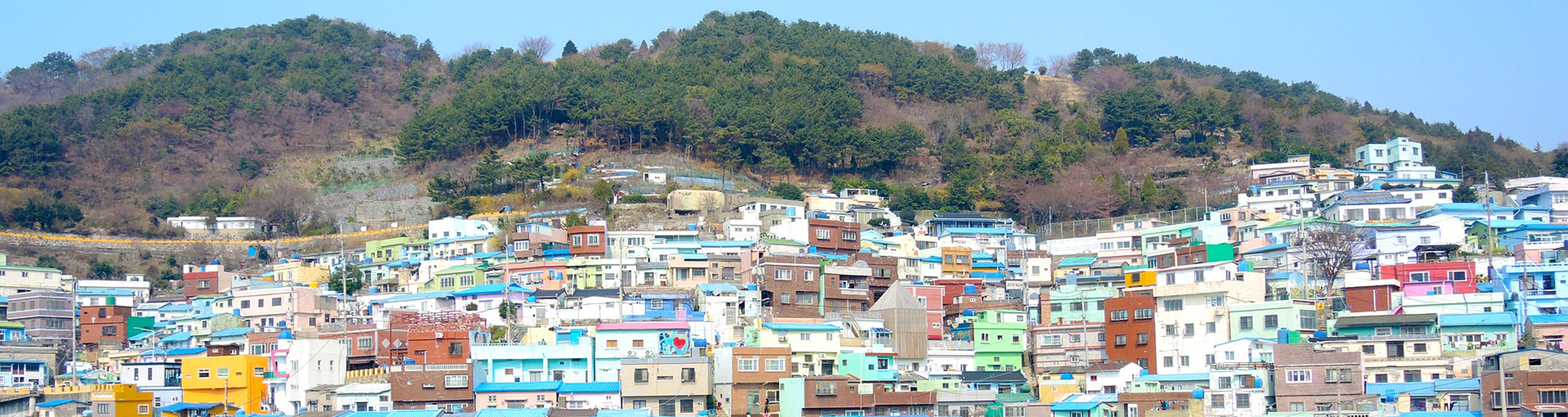
BUSAN is South Korea's largest port city and its chief economic hub on the coast, beautifully situated where majestic mountains meet the roaring Pacific Ocean. Known for its vibrant beaches, historic temples, and scenic cliffs, it serves as a dynamic international gateway linking the Asian continent to the global maritime network. It offers an eclectic blend of deep-rooted cultural traditions, world-class film festivals, and a bustling metropolitan lifestyle.
Capital of South Korea: Seoul
Location: Located on the southeastern tip of the Korean Peninsula at longitude $129^\circ$ E and latitude $35^\circ$ N. It sits on a similar latitude to Tokyo, Kabul, Los Angeles, Memphis, Beirut, and Algiers.
Population: The population of Busan is approximately 3.3 million, while the total population of South Korea is around 51.7 million.
Climate: Marine subtropical; generally temperate with four distinct seasons. Rainfall is significantly heavier in the summer monsoon months than in the winter.
Local Time: Busan is on Korea Standard Time (KST), which is UTC/GMT +9. South Korea does not observe Daylight Saving Time. This makes Busan 16 hours ahead of Los Angeles (or 17 hours ahead when Los Angeles is on Standard Time).National Day: Liberation Day (Gwangbokjeol), celebrated on August 15 to commemorate the 1945 liberation from colonial rule.
Flag of South Korea: Known as the Taegeukgi, it features a white background with a red (top) and blue (bottom) yin-yang symbol (taegeuk) in the center. Four unique black trigrams from the ancient I Ching (Book of Changes) occupy the corners of the white field, representing universal harmony, symmetry, and balance.

Contact
200 N Spring St.
Los Angeles, CA 90012
Email: sistercities@lacity.org
Website: sistercities.lacity.org